
Code: Select all
x = 33, y = 15, rule = B3678/S34678
5b2o$3b6o14bob2o$b10o10b2ob5obo$b12o8b9ob2o$2b11o9b11o$2b10o10b10o$obo
b8o9b11o$obob6obobo7b12o$2b8obobo8b11o$2b10o10b10o$b11o9b11o$b12o8b2ob
9o$3b10o10bob5ob2o$5b6o16b2obo$7b2o!
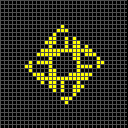
The oscillator on the right has period 2. Every cell either is permanently dead, or is permanently alive (a bit that belongs in the stator of the oscillator), or oscillates at period 2. Since there is a cell oscillating at full period of the oscillator, it is not trivial. (Indeed, a prime-period oscillator cannot be trivial.) Further, the whole p2 oscillator is a single strict object (the rules use Moore neighbourhood and the oscillator has a polyplet phase, so it is connected with respect to the same adjacency that is used to define the neighbourhood and the evolution rules).
Despite being nontrivial strict oscillators, both are "boring" because each of them has a disconnected rotor. How to refer to such "boring" oscillators, without redefining the existing notion of triviality?
What are other useful or interesting notions that can be viewed as extensions or variations of triviality?
Starting a new thread since this appears to deserve some more brainstorming.