WhiteHawk wrote: January 24th, 2025, 11:03 am
[...] the nearest rule to B35/S23 which supports the glider [...] B35-n/S23 [...]
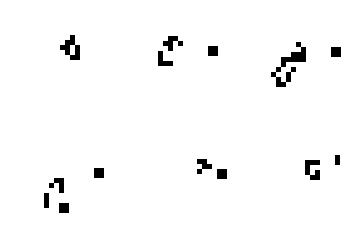
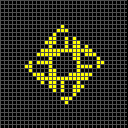
I think you'll need to specify the CA family or otherwise add a restriction, else the following CA is arguably closer than that:
Code:
Select all
x = 30, y = 23, rule = R2,C0,S34-67,B51-67,86-101,NW01010101010111111101011100110101111111010101010101
11bo$12bo$10b3o2$27bo$27bobo$27b2o13$2b3o$bo3bo$o2bo2bo$3ob3o!
It's "ring-totalistic" / "layer-totalistic", the condition of a cell is an encoded form of the tuple (the cell's own current state between 0 and 1, the number of alive range-1 neighbours between 0 and 8, the number of alive range-2 neighbours between 0 and 16). In particular the omitted birth condition B85 is an encoded form of the tuple (0, 5, 0) which means "the cell is currently dead, has precisely five alive range-1 neighbours, and has zero alive range-2 neighbours". If the birth condition B85 is added, then the CA will be equivalent to B35/S23.
WhiteHawk wrote: January 24th, 2025, 11:03 am
[...] the nearest isotropic non-totalistic rule to B35/S23 [...]
That doesn't resolve the problem. The above CA I posted is isotropic, and non-totalistic.
There is no "nearest isotropic non-totalistic" CA to B35/S23, you can always go closer and closer and closer.
127:1
B3/S234c User:Confocal/R (isotropic CA, incomplete)
Unlikely events happen.
My silence does not imply agreement, nor indifference. If I disagreed with something in the past, then please do not construe my silence as something that could change that.