
Thread for basic non-CGOL questions
-
tommyaweosme

- Posts: 1581
- Joined: January 15th, 2024, 9:37 am
Re: Thread for basic non-CGOL questions
i assume empty emptiness means the oscillator-like things it leaves, like plow world but slightly different.
here's the gosper glider gun
Code: Select all
#R life
24bo$22bobo$12b2o6b2o12b2o$11bo3bo4b2o12b2o$2o8bo5bo3b2o$2o8bo3bob2o4b
obo$10bo5bo7bo$11bo3bo$12b2o!-
Empty Emptiness
- Posts: 48
- Joined: June 10th, 2024, 12:08 pm
Re: Thread for basic non-CGOL questions
confocaloid wrote: June 11th, 2024, 8:33 am Welcome to the forums!
The question is a bit unclear; what are you asking about? Random soups grow without leaving any well-separated oscillators. On the other hand, cellular automata such as Conway's Life (B3/S23) have infinitely many distinct oscillators.
Code: Select all
x = 10, y = 10, rule = B3/S0145678
bobob2ob2o$ob4o3bo$bobo2b4o$obobo3bo$bob2o4bo$ob2o2b3o$ob2o2bob2o$bob
4o2bo$bo2b5o$2o5bobo!
Code: Select all
x = 47, y = 11, rule = B3/S0145678
25bob2obo$16bo8b6o$16bo6b10o$7b2o6b3o6b8o7bo3bo$2bo4b2o5b5o6b6o6b3o4b
2o$2o5b2o5b5o4bob6obo4b3o6bo$7b2o6b3o7b6o5b3o$16bo7b8o$16bo6b10o$25b6o
$25bob2obo!
Also, I have changed my signature.
Code: Select all
x = 27, y = 7, rule = B2ci3ai4c8/S02ae3eijkq4iz5ar6i7e
8bo14bo$6b5o10b5o$6bo3bo10bo3bo$b2o2b2obobo9b2obob2o$2bo3bo3bo10bo3bo$
o5b5o10b5o$8bo14bo!
-
Empty Emptiness
- Posts: 48
- Joined: June 10th, 2024, 12:08 pm
Re: Thread for basic non-CGOL questions
nopetommyaweosme wrote: June 11th, 2024, 8:41 am i assume empty emptiness means the oscillator-like things it leaves, like plow world but slightly different.
Also, I have changed my signature.
Code: Select all
x = 27, y = 7, rule = B2ci3ai4c8/S02ae3eijkq4iz5ar6i7e
8bo14bo$6b5o10b5o$6bo3bo10bo3bo$b2o2b2obobo9b2obob2o$2bo3bo3bo10bo3bo$
o5b5o10b5o$8bo14bo!
-
Banananananan
- Posts: 236
- Joined: May 5th, 2024, 8:52 pm
Re: Thread for basic non-CGOL questions
Difference between Corderoid and cordership?
Also: can a b1 rule not explode?(any b1, isotropic, or generations)
Also: can a b1 rule not explode?(any b1, isotropic, or generations)

-
confocaloid
- Posts: 6697
- Joined: February 8th, 2022, 3:15 pm
- Location: learn to protect yourself against stray gliders and sparks and self-destruct mechanisms
Re: Thread for basic non-CGOL questions
A Cordership is a spaceship that moves diagonally with simplified speed c/12 (the actual period is higher), and is based on the switch engine from Conway's Life.
An example of a Cordership is the 2-engine Cordership. Not counting Life (B3/S23), there are also known Corderships in B3/S236e. By allowing three or more cellstates, or by allowing higher-range weighted neighbourhoods, it's possible to find other cellular automata with Corderships.
A corderoid is any engineered spaceship that is entirely made out of interacting instances of some moving engine. There might be several instances of a puffer engine, arranged and phased in such a way that their interaction removes all the ash and the pattern becomes a spaceship. Instead of a puffer engine, there could be an unstable object that would not continue to move by itself.
Last edited by confocaloid on June 13th, 2024, 6:09 pm, edited 1 time in total.
127:1 B3/S234c User:Confocal/R (isotropic CA, incomplete)
Unlikely events happen.
My silence does not imply agreement, nor indifference. If I disagreed with something in the past, then please do not construe my silence as something that could change that.
Unlikely events happen.
My silence does not imply agreement, nor indifference. If I disagreed with something in the past, then please do not construe my silence as something that could change that.
-
b-engine

- Posts: 3762
- Joined: October 26th, 2023, 4:11 am
- Location: Somewhere on where Earth At
- Contact:
Re: Thread for basic non-CGOL questions
1. Corderoids are a family of spaceships that consists of stabilized puffers or unstable "moving" objects. Corderships are a subset of corderoid that consists of corder engines.Banananananan wrote: June 13th, 2024, 5:14 pm Difference between Corderoid and cordership?
Also: can a b1 rule not explode?(any b1, isotropic, or generations)
2. There's at least a non-explosive B1e rule with soups that stabilize into photons, or occasionally oscillator or even a gun:
Code: Select all
# You can find this in Request a Rule to be "Tamed" thread
#R B1e2cek3cjkry4jrw5cny6ck7c/S2kn3-aejr4knqty5ejk6e
!
#C [[ RANDOMIZE ]] Try INT Minesweeper
-
tommyaweosme
- Posts: 1581
- Joined: January 15th, 2024, 9:37 am
Re: Thread for basic non-CGOL questions
me have a new format for yall to check out!
everything is optional (except rle)
if rule is emited, its life
if settings is emited, nothing happens
all problem am solve! (just need update to lifeiewer for that happen)
Code: Select all
r=(rule)
(rle)
c (settings)
if rule is emited, its life
if settings is emited, nothing happens
all problem am solve! (just need update to lifeiewer for that happen)
here's the gosper glider gun
Code: Select all
#R life
24bo$22bobo$12b2o6b2o12b2o$11bo3bo4b2o12b2o$2o8bo5bo3b2o$2o8bo3bob2o4b
obo$10bo5bo7bo$11bo3bo$12b2o!Re: Thread for basic non-CGOL questions
Do you have shares in a competitor to Golly or something?
User:HotdogPi/My discoveries
Periods discovered:
All evens ≤128 except 52,58,78,82,92,94,98,104,118,122
5-15,㉕-㉛,㉟㊺,51,63,65,73,75
1㊳㊵㊹㊼㊽,54,56,72,74,80,90,92
217,240,300,486,576
Guns: 20,21,32,54,55,57,114,117,124,126
SKOPs: 32,74,76,102,196
Periods discovered:
All evens ≤128 except 52,58,78,82,92,94,98,104,118,122
5-15,㉕-㉛,㉟㊺,51,63,65,73,75
1㊳㊵㊹㊼㊽,54,56,72,74,80,90,92
217,240,300,486,576
Guns: 20,21,32,54,55,57,114,117,124,126
SKOPs: 32,74,76,102,196
-
tommyaweosme
- Posts: 1581
- Joined: January 15th, 2024, 9:37 am
Re: Thread for basic non-CGOL questions
r= is much easier to type
you know what, just r
so rlife and rb3s35 are rule referring
and czoom16 is [[ ZOOM 16 ]]
edit: i JUST NOTICED that empty emptiness's b3s0145678 kills still lifes that are in regular life. aka, things that die in one generation in this rule are still lifes in life. take advantage and find small sparks. convert them into life, and get big still life.
maybe useful for heshel condits
you know what, just r
so rlife and rb3s35 are rule referring
and czoom16 is [[ ZOOM 16 ]]
edit: i JUST NOTICED that empty emptiness's b3s0145678 kills still lifes that are in regular life. aka, things that die in one generation in this rule are still lifes in life. take advantage and find small sparks. convert them into life, and get big still life.
maybe useful for heshel condits
here's the gosper glider gun
Code: Select all
#R life
24bo$22bobo$12b2o6b2o12b2o$11bo3bo4b2o12b2o$2o8bo5bo3b2o$2o8bo3bob2o4b
obo$10bo5bo7bo$11bo3bo$12b2o!-
confocaloid
- Posts: 6697
- Joined: February 8th, 2022, 3:15 pm
- Location: learn to protect yourself against stray gliders and sparks and self-destruct mechanisms
Re: Thread for basic non-CGOL questions
As written, this sounds like a shortcut that would allow finding big still lives without actually searching for big still lives, which would indeed be truly remarkable. Unfortunately as far as I can tell that doesn't really make the problem easier; how do you find things that die in one generation in B3/S0145678?tommyaweosme wrote: June 13th, 2024, 9:07 pm edit: i JUST NOTICED that empty emptiness's b3s0145678 kills still lifes that are in regular life. aka, things that die in one generation in this rule are still lifes in life. take advantage and find small sparks. convert them into life, and get big still life.
maybe useful for heshel condits
127:1 B3/S234c User:Confocal/R (isotropic CA, incomplete)
Unlikely events happen.
My silence does not imply agreement, nor indifference. If I disagreed with something in the past, then please do not construe my silence as something that could change that.
Unlikely events happen.
My silence does not imply agreement, nor indifference. If I disagreed with something in the past, then please do not construe my silence as something that could change that.
-
tommyaweosme
- Posts: 1581
- Joined: January 15th, 2024, 9:37 am
Re: Thread for basic non-CGOL questions
by using a spark searcher. its easy to find sparks, more than still lifes
here's the gosper glider gun
Code: Select all
#R life
24bo$22bobo$12b2o6b2o12b2o$11bo3bo4b2o12b2o$2o8bo5bo3b2o$2o8bo3bob2o4b
obo$10bo5bo7bo$11bo3bo$12b2o!-
confocaloid
- Posts: 6697
- Joined: February 8th, 2022, 3:15 pm
- Location: learn to protect yourself against stray gliders and sparks and self-destruct mechanisms
Re: Thread for basic non-CGOL questions
It's not too hard to find still lives using software. For example, I just found a large still life in Life using Logic Life Search:tommyaweosme wrote: June 13th, 2024, 9:51 pm by using a spark searcher. its easy to find sparks, more than still lifes
Code: Select all
x = 20, y = 20, rule = B3/S23
bo3b2o3bob2ob2ob2o$obo2bobo2b2obobo3bo$bobobobo5bo2b2o$3bobob2o4bo3b2o
$2bobo5b2obobo3bo$2bobob4obob2ob4o$b2obo2bo8bo$o2bobo6b3o3b2o$bobob2o
4bo2b2o3bo$2obo3bo2bobo5bo$o2bo3bo3bo5bo$2b2obob4o4b3obo$4b2o4bobobo3b
2o$3o3b2o3bob2obo$o2b2obo2bobo3b2ob2o$3bo2bob2o2b2o3bobo$4b3o3bobo4bo$
b3o3b2obobobo3bo$bo2bo2bobo3b2o2b2o$3b2o3bo!

# ./lls -b 20 20 -s p1 -p '>150'
Getting search pattern...
Done

Preprocessing...
Done

Width: 22
Height: 22
Duration: 2

Number of undetermined cells: 400
Number of variables: 3791
Number of clauses: 124166

x = 22, y = 22, rule = B3/S23
bbbbbbbbbbbbbbbbbbbbbb$
bbobbboobbboboobooboob$
bobobbobobboobobobbbob$
bbobobobobbbbbobboobbb$
bbbboboboobbbbobbboobb$
bbbobobbbbboobobobbbob$
bbboboboooobobooboooob$
bboobobbobbbbbbbbobbbb$
bobbobobbbbbbooobbboob$
bboboboobbbbobboobbbob$
boobobbbobbobobbbbbobb$
bobbobbbobbbobbbbbobbb$
bbbooboboooobbbbooobob$
bbbbboobbbbobobobbboob$
booobbboobbboboobobbbb$
bobboobobbobobbbooboob$
bbbbobboboobboobbbobob$
bbbbbooobbbobobbbbobbb$
bbooobbboobobobobbbobb$
bbobbobbobobbboobboobb$
bbbboobbbobbbbbbbbbbbb$
bbbbbbbbbbbbbbbbbbbbbb!


Total solver time: 0.0927116870880127
127:1 B3/S234c User:Confocal/R (isotropic CA, incomplete)
Unlikely events happen.
My silence does not imply agreement, nor indifference. If I disagreed with something in the past, then please do not construe my silence as something that could change that.
Unlikely events happen.
My silence does not imply agreement, nor indifference. If I disagreed with something in the past, then please do not construe my silence as something that could change that.
-
tommyaweosme
- Posts: 1581
- Joined: January 15th, 2024, 9:37 am
Re: Thread for basic non-CGOL questions
rlifesrc is quicker with that i think
here's the gosper glider gun
Code: Select all
#R life
24bo$22bobo$12b2o6b2o12b2o$11bo3bo4b2o12b2o$2o8bo5bo3b2o$2o8bo3bob2o4b
obo$10bo5bo7bo$11bo3bo$12b2o!-
confocaloid
- Posts: 6697
- Joined: February 8th, 2022, 3:15 pm
- Location: learn to protect yourself against stray gliders and sparks and self-destruct mechanisms
Re: Thread for basic non-CGOL questions
What is the lifespan of this pattern?tommyaweosme wrote: June 14th, 2024, 3:14 pm (i really want to win highest lifespan on tori b3/s23 by placing a really high period glider tracks with lcm)
Code: Select all
x = 40, y = 40, rule = B3-ry/S23-ky
19bo$18bobo$18bobo$19bo4$27bo$28bo$26b3o2$11b2o$10bobo$12bo2$37b2o$36b
o2bo$b2o34b2o$o2bo$b2o4$30bo$30bobo$30b2o2$13b3o$13bo$14bo7$20bo$19bob
o$19bobo$20bo!
/object/PATHOLOGICAL/b3s23 wrote: On 2022-09-28 at 05:09:53 UTC, haukeworpel wrote:
In b3-rys23-ky there is a glider-beehive collision where the beehive is shifted five cells and the glider is reflected 90 degrees. This "pathological" pattern is four of these reactions arranged in a square that expands with every collision.
127:1 B3/S234c User:Confocal/R (isotropic CA, incomplete)
Unlikely events happen.
My silence does not imply agreement, nor indifference. If I disagreed with something in the past, then please do not construe my silence as something that could change that.
Unlikely events happen.
My silence does not imply agreement, nor indifference. If I disagreed with something in the past, then please do not construe my silence as something that could change that.
-
confocaloid
- Posts: 6697
- Joined: February 8th, 2022, 3:15 pm
- Location: learn to protect yourself against stray gliders and sparks and self-destruct mechanisms
Re: Thread for basic non-CGOL questions
I can see several possible ways to interpret the question (i.e. it's still ambiguous). Depending on the interpretation, one can determine several different lower bounds (I don't know whether these lower bounds are attainable):wwei47 wrote: June 7th, 2024, 11:23 amI meant neighborhood; not transition. I completely forgot that that was a word and fell back onto "transition" because I couldn't think of the right word. That is on me.confocaloid wrote: June 7th, 2024, 5:40 amI think you need to include some additional details/explanations about exactly what you are trying to do, before your question becomes clear, unambiguous and answerable. [...]wwei47 wrote: June 6th, 2024, 6:26 pm What is the smallest pattern by bounding box that contains every B34567 transition and every S1234567 transition? I was able to get 15 by 13.Code: Select all
x = 15, y = 13, rule = B/S012345678History
.4B.2BABA2BA$.3ABA2BA2B2AB$.ABABA2BABABAB$.BAB2ABABA5B$.4BA2BA2B2A2B$
.BABA2BAB2AB2AB$.7AB3AB2A$2BA3BAB2A2BA2B$BAB5AB2ABA2B$6B5A3BA$.2B2AB
4ABAB2A$2.B2A3BA2BAB2A$2.BA4BA4B2A!
Isotropic conditions?
Up to rotations and reflections (one can look through the table),a possible way to interpret the question wrote:A cell can be in one of two states ("off", "on").
A 3-by-3 configuration of cells is said to be strange iff one of the following conditions is met:What is the smallest bounding box area of a known pattern (including all specified cells, both "on" and "off") that contains some orientation of every strange 3-by-3 configuration?
- (a) the middle cell is "off", and the number of "on" neighbours is between 3 and 7;
- (b) the middle cell is "on", and the number of "on" neighbours is between 1 and 7.
- there are 10+13+10+6+2 = 41 strange configurations due to (a),
- there are 2+6+10+13+10+6+2 = 49 strange configurations due to (b),
With positive integer m, n, what is the lowest possible value (m+2)(n+2) such that mn >= 90? Assume m >= n; then
- if n = 1 then m >= 90, (m+2)(n+2) >= 276
- if n = 2 then m >= 45, (m+2)(n+2) >= 188
- if n = 3 then m >= 30, (m+2)(n+2) >= 160
- if n = 4 then m >= 23, (m+2)(n+2) >= 150
- if n = 5 then m >= 18, (m+2)(n+2) >= 140
- if n = 6 then m >= 15, (m+2)(n+2) >= 136
- if n = 7 then m >= 13, (m+2)(n+2) >= 135
- if n = 8 then m >= 12, (m+2)(n+2) >= 140
- if n = 9 then m >= 10, (m+2)(n+2) >= 132
Neighbour-counting conditions?
A lower bound on the bounding box area is 30, via the same reasoning as before. (To demonstrate every strange condition at least once, the pattern must contain at least 12 distinct fully specified 3-by-3 configurations. If the middle cells of those 12+ configurations lie inside a m-by-n rectangle, then the bounding box of the pattern is (m+2)-by-(n+2). The possibilities are n = 1, m >= 12, bb >= 42; n = 2, m >= 6, bb >= 32; n = 3, m >= 4, bb >= 30.)a possible way to interpret the question wrote:A cell can be in one of two states ("off", "on").
A neighbour-counting condition with range-1 Moore neighbourhood can be fully specified by telling the state of the middle cell ('B' = "off", 'S' = "on") and the number of "on" neighbours of the cell.
The twelve conditions B3, B4, B5, B6, B7, S1, S2, S3, S4, S5, S6, S7 are said to be strange, and there are no other strange conditions.
What is the smallest bounding box area of a known pattern (including all specified cells, both "on" and "off") that contains every strange condition?
I think the following pattern provides an upper bound of 42:
Code: Select all
#C green (LifeHistory state 1) = specified on
#C red (LifeHistory state 4) = specified off
#C Neighbour-counting conditions, left to right: B7, B6, B5, S5, S6, S7, S4, B4, B3, S3, S2, S1.
x = 14, y = 3, rule = LifeHistory
4AD2A2DA4D$A3D4A2D3AD$4AD3ADA4D!
Distinguishing rotations and reflections, there are 218 strange configurations due to (a) and 254 strange configurations due to (b), so the pattern must contain at least 218+254 = 472 distinct fully specified 3-by-3 configurations. If the middle cells of those 472+ configurations lie inside a m-by-n rectangle, then the bounding box of the pattern is (m+2)-by-(n+2). Enumerating possible widths as before gives the lower bound 567 (if n = 19 and m = 25).a possible way to interpret the question wrote:A cell can be in one of two states ("off", "on").
A 3-by-3 configuration of cells is said to be strange iff one of the following conditions is met:What is the smallest bounding box area of a known pattern (including all specified cells, both "on" and "off") that contains every strange 3-by-3 configuration?
- (a) the middle cell is "off", and the number of "on" neighbours is between 3 and 7;
- (b) the middle cell is "on", and the number of "on" neighbours is between 1 and 7.
127:1 B3/S234c User:Confocal/R (isotropic CA, incomplete)
Unlikely events happen.
My silence does not imply agreement, nor indifference. If I disagreed with something in the past, then please do not construe my silence as something that could change that.
Unlikely events happen.
My silence does not imply agreement, nor indifference. If I disagreed with something in the past, then please do not construe my silence as something that could change that.

Re: Thread for basic non-CGOL questions
Can someone with more computing power figure out if this grows quadratically?
Code: Select all
x = 98, y = 99, rule = B36/S23
$74b3o$74bo2bo$74bo3bo$75bo2bo$76b3o43$23b3o$22bo2bo$21bo3bo$21bo2bo$
21b3o9$14b3o$13bo2bo$12bo3bo$12bo2bo$12b3o16$15b3o$14bo2bo$13bo3bo$13b
o2bo$13b3o!
-
tommyaweosme
- Posts: 1581
- Joined: January 15th, 2024, 9:37 am
Re: Thread for basic non-CGOL questions
looks like yes
here's the gosper glider gun
Code: Select all
#R life
24bo$22bobo$12b2o6b2o12b2o$11bo3bo4b2o12b2o$2o8bo5bo3b2o$2o8bo3bob2o4b
obo$10bo5bo7bo$11bo3bo$12b2o!-
confocaloid
- Posts: 6697
- Joined: February 8th, 2022, 3:15 pm
- Location: learn to protect yourself against stray gliders and sparks and self-destruct mechanisms
Re: Thread for basic non-CGOL questions
The single sentence reply "looks like yes" neither answers the question "Can someone with more computing power figure out if this grows quadratically?" in the preceding post, nor otherwise contributes something valuable to the discussion. Did someone run the pattern (how long? what were the results?) Was there some analysis of the evolution of the pattern?
I guess I could just use the report feature (forum rule 4) instead of replying; decided to reply instead. Both the quoted single-line reply, and this reply to that reply, could just as well not be here, without any negative consequences for the accumulated knowledge about Life/CA.
127:1 B3/S234c User:Confocal/R (isotropic CA, incomplete)
Unlikely events happen.
My silence does not imply agreement, nor indifference. If I disagreed with something in the past, then please do not construe my silence as something that could change that.
Unlikely events happen.
My silence does not imply agreement, nor indifference. If I disagreed with something in the past, then please do not construe my silence as something that could change that.
Re: Thread for basic non-CGOL questions
There was some analysis of the pattern, by me, around 150.000 generations. There appears to be a replicator puffer heading northwest, but it is VERY dirty. I'm not sure if its stabilised state produces replicators by itself.
-
silversmith

- Posts: 470
- Joined: June 15th, 2020, 6:20 pm
- Location: Pennsylvania, USA, Earth, Sector 5ff63D6
Re: Thread for basic non-CGOL questions
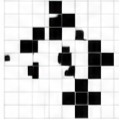
I ran the pattern for ~1.5 million generations, and there's no sign that it stabilized into something quadratic. The area of interaction seems too chaotic for anything like a space filler, while the replicators which are produced by the main puffers tend to collide with debris and eventually form a bomber backend which causes them to shrink over time, or at least not grow linearly.
- QuarterSize.png (14.25 KiB) Viewed 6168 times
-
unname4798
- Posts: 2532
- Joined: July 15th, 2023, 10:27 am
- Location: Near ConwayLife servers
Re: Thread for basic non-CGOL questions
tommyaweosme wrote: June 13th, 2024, 8:59 pm me have a new format for yall to check out!everything is optional (except rle)Code: Select all
r=(rule)
(rle)
c (settings)
if rule is emited, its life
if settings is emited, nothing happens
all problem am solve! (just need update to lifeiewer for that happen)
Code: Select all
XXYYTRRRrleC
XX - Width
YY - Height
T - Bounded grid type
RRR - OTCA rulestring
C - Settings
All numbers are in base 64.
RRR and C are optional.
If there is no RRR, the rule would be Life.
If there is no C, default LV settings are used.
-
tommyaweosme
- Posts: 1581
- Joined: January 15th, 2024, 9:37 am
Re: Thread for basic non-CGOL questions
XXYYT should be optional
here's the gosper glider gun
Code: Select all
#R life
24bo$22bobo$12b2o6b2o12b2o$11bo3bo4b2o12b2o$2o8bo5bo3b2o$2o8bo3bob2o4b
obo$10bo5bo7bo$11bo3bo$12b2o!-
unname4798
- Posts: 2532
- Joined: July 15th, 2023, 10:27 am
- Location: Near ConwayLife servers
Re: Thread for basic non-CGOL questions
T is optional, I just didn't mention it being optional. As for XXYY:
XX is pattern width.
YY is pattern height. (Both have the max value of 4096 and are required)
, is required to separate RLE from X, Y, bounded grid type and rule. It is also used for separating RLE from commands.
-
tommyaweosme
- Posts: 1581
- Joined: January 15th, 2024, 9:37 am
Re: Thread for basic non-CGOL questions
00 works just fine, so i dont know why it isnt optional
here's the gosper glider gun
Code: Select all
#R life
24bo$22bobo$12b2o6b2o12b2o$11bo3bo4b2o12b2o$2o8bo5bo3b2o$2o8bo3bob2o4b
obo$10bo5bo7bo$11bo3bo$12b2o!-
Banananananan
- Posts: 236
- Joined: May 5th, 2024, 8:52 pm
Re: Thread for basic non-CGOL questions
How do Map transitions work? What do all the letters mean? It looks confusing. 