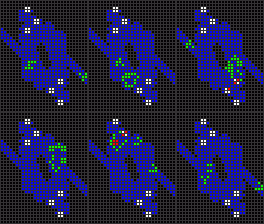
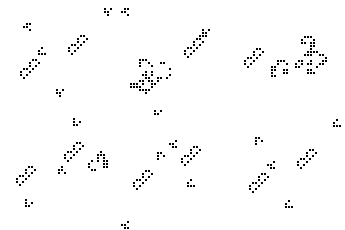
Gustavo6046 wrote:Nope, that extra glider isn't reflected -- it isn't even part of (f)reaction!
A for awesome is trying to explain an important point. People don't usually look for a way to do something with the largest number of gliders. If fewer gliders can accomplish the same task, then simpler is better.
Look at generation 250 of your pattern, and then generation 250 of this pattern:
Code: Select all
x = 58, y = 65, rule = B3/S23
39bo$37b2o16bobo$38b2o15b2o$56bo59$o$o$o!
After all of the hurly-burly's done, you get to the exact same place. Yes, it's absolutely true that your pattern absorbed a lot of gliders and created a new one. But going by the results, you might as well have saved a lot of trouble and not put in all those gliders in the first place.
Now, in some cases you might
already have all those gliders in a larger pattern and want to get rid of them. This kind of thing comes up in the (23,5)c/79 'waterbear' knightship, for example, where extra gliders are a real problem to be solved -- if they aren't absorbed somehow, the knightship won't work.
In your pattern, the only problem is one that you created yourself: an unnecessarily large dying spark, full of sound and fury, signifying nothing.
-- Now, here's a challenge for you! A blinker takes two gliders to build, so the above pattern is equivalent to a four-glider recipe for that pond and that glider. That's
still not optimal -- there are lots of three-glider equivalent patterns. If you can find one of them, I think it would be somewhat reassuring to all of us who have been trying to explain the basics of this topic to you.
(Yes, it's a slightly silly challenge, because one glider still won't interact at all. For bonus points, use four gliders that all come from the southeast and southwest, to produce the same pond+glider combination.)

 ) by 20 will reveal the time where the Nazism was up, sorry if I offended anyone as it wasn't intended indeed, I didn't got nazi essence, only german one from patern family...). Rehermann = Man from Reher, Reher is a little town in Germany,
 .