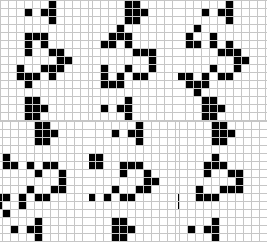
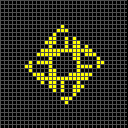
I tried deleting the smaller square to see if anything popped out, and even though I could only delete a few rows in a reasonable amount of time, that turned out to be enough to see them while scrolling across. Anyway, there are 8 "knobs" on the side that look like this:
Code: Select all
x = 15, y = 9, rule = B2-a3-ij4-ceity5-cqry6-cn78/S012-n3an4aenqtyz5aeij678
7bo$7ob7o$15o$15o$15o$15o$15o$15o$15o!
Because the protruding cell is balanced out by a missing cell, the population is equal to that of the square.
They are located at (61,293, 387,639), (-61,291, 387,639), (-387,638, -61,292), (-387,638, 61,292), (61,293, -387,639), (-61,291, -387,639), (387,640, -61,292) and (387,640, 61,292). A little signal travels up the wavefront and lands at these spots at generation 978,388 (its signal form does include a phase as this protrusion). I have not determined where the signals came from and I don't care to.
EDIT: I apologize for getting off-topic. Technically the smallest metacell is from B1357/S1357 or B1357/S2468, which simulates itself at a speed of 1/2:
Code: Select all
x = 21, y = 24, rule = B1357/S1357
2o16bobo19$2o16bobo$bo$bo18bo2$20bo!
The metacell is a 2*2 square with a single cell in the corner, and it simulates itself.
EDIT 2:
Sawtooth with minimum population 3:
Code: Select all
x = 10, y = 1, rule = B2cik3-cikq4eijtyz5eijk6cn7c/S02ikn3-aiy4iqrtwy5-ckn6-an7c
obo6bo!
This is the minimum minimum population for a sawtooth, since there are only finitely many 2-cell patterns that are active {a}. The B1c/S and B2a/S replicators have minimum population 4.
{a}: With a B1 transition, infinitely many such patterns exist, but they consist of isolated dots, and those dots will expand in all directions and never stop, meaning that the population will always be at least 4.
Any sufficiently advanced software is indistinguishable from malice.