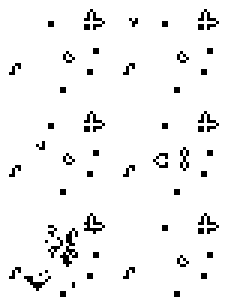
I've done a census of all
polyominoes whose cell count <=18. (results available in Catalogue(b3s23/polyominoes_stdin)) Turns out they're quite dull. There are very few types of oscillators, and none of them are rare. Only the 4 types of basic spaceships emerge(gliders and x-WSSes), not even a flotilla. Only two types of linear growth patterns show up, and they are simply BLSE and GPSE. Nevertheless, at least all my findings are predecessors that are polyominoes?

So here are a few smallest polyomino(smallest as in smallest alive cell count, and if there are more then one of them, I arbitrarily choose some) that produces certain objects:
nonomino that produces a
LWSS(legacy, already discovered in 1970s):
Code: Select all
x = 4, y = 4, rule = B3/S23
b3o$2obo$o2bo$o!
11-omino that becomes a
MWSS in 4 gen:
Code: Select all
x = 5, y = 4, rule = B3/S23
5o$2b2o$b3o$bo!
11-omino that produces a
HWSS:
Code: Select all
x = 7, y = 5, rule = B3/S23
2bo$2b5o$b2o$2o$o!
18-ominoes that produces a p3
Jam:
Code: Select all
x = 30, y = 7, rule = B3/S23
2b2o22b2o$2obo20b6o$b7o16bo$2o19b4o$bo19bo2bo$2o19bo$o19b2o!
17-omino that becomes a p4
Mold in 6 gen:
Code: Select all
x = 8, y = 6, rule = B3/S23
4bo$4b2o$2bo2b2o$8o$b2o$bo!
18-ominoes that produces a p4
Mazing:
Code: Select all
x = 88, y = 8, rule = B3/S23
4bo3b3o31b4o38bob2o$4b5o31b2obob2o37b3o$6o35b3o36bo3bo$o2bobo34b2ob3o
34b5o$41bo38bobo$80bo$80bo$80bo!
17-omino that becomes a p8
Blocker:
Code: Select all
x = 9, y = 4, rule = B3/S23
bo5bo$b5ob2o$bo2b4o$2o3bo!
18-omino that produces a p30
Cis-queen bee shuttle(and a methuselah of 2155 gen):
Code: Select all
x = 8, y = 7, rule = B3/S23
6b2o$4bo2bo$bo2b4o$b4o$bo$b2o$2o!
14-omino that exhibits infinite growth(
BLSE)(maybe it wins the smallest bounding box?):
Code: Select all
x = 7, y = 5, rule = B3/S23
b6o$obo$3o$2bo$b2o!
16-omino that produces a
GPSE(9x3 bounding box)(does this one wins the smallest bounding box for a GPSE?):
Code: Select all
x = 9, y = 3, rule = B3/S23
b3ob3o$2ob3ob2o$2o5bo!
And a few methuselahs/diehards/megasized patterns...
17-omino M22164
Code: Select all
x = 10, y = 6, rule = B3/S23
4b6o$4bo$4bo$2o2b2o$b4o$bo!
18-omino diehards in 498 gen:
Code: Select all
x = 50, y = 5, rule = B3/S23
44bo2bo$4b5o35bob4o$b6obo32b6o$bo3b2o34bo3bo$3o37b3o!
18-omino M23314(
Blom relative):
Code: Select all
x = 13, y = 4, rule = B3/S23
6b2o$5b8o$6o2bo$4bo!
18-omino M20661:
Code: Select all
x = 10, y = 5, rule = B3/S23
3b4o$3bo2b4o$o2bo4bo$4o4bo$o!
18-omino megasized pattern of 3421 alive cells:
Code: Select all
x = 9, y = 5, rule = B3/S23
2b5o$5bo$5bo$9o$o2bo!
On a side note, enumerating and storing all 192 million 18-ominoes as .RLEs is not as easy as I thought it would be, I probably couldn't spend more storage(both RAM and disk) to enumerate and store the 742 million 19-ominoes. The .rle files of all 18-and-below-ominoes takes 1.15GB of disk space as one compressed .zip file with a compression rate of 94%(if expanded, it'll be likely 20GBs). And the total number of n-ominoes grows by a factor of approximately 4, according to
https://oeis.org/A000105, for that reason I'm pessimistic about reaching 20-ominoes and above on a PC. If anyone wants to try larger polyominoes the info above might be helpful.