Thread for basic questions

A place, especially for newcomers, to ask questions and learn the basics.
User avatar
dvgrn
Moderator
Posts: 12036
Joined: May 17th, 2009, 11:00 pm
Location: Madison, WI
Contact:

Re: Thread for basic questions

Post by dvgrn »

pipsqueek wrote: February 22nd, 2023, 2:08 pm
hotdogPi wrote: February 22nd, 2023, 1:56 pm The best way to search for an elementary replicator is apgsearch with symmetric soups, i.e. we're already doing that.
who's to say that it will be symmetric? and how do you know its the best way? Im sure there is a more efficient specialized method of searching for replicators. if we haven't found one already, then maybe our search efforts aren't effective enough.
I'm guessing that hotdogPi was aiming at an idea that could be phrased like this instead:

"We're already searching for small elementary replicators in the best way that anyone can currently think of."

It seems fairly unlikely that anyone will start running a hypothetical highly-optimized search that only looks for replicators, any time soon.

The problem is that there's very likely no way to exhaustively cover the 25x25 search space you're describing, even using all of Earth's current computer hardware, before the Sun turns into a red giant and swallows the Earth.

We definitely could start a replicators-only search, planning to cover only a random infinitesimal fraction of the space, but if we specialize in elementary replicators then we'll probably find exactly zero interesting things during the entire search -- and eventually we'll stop searching out of sheer boredom.

On the other hand, if we go the maybe slightly less efficient route of using apgsearch, we'll discover lots of entertaining things along the way, and that will make it seem more worthwhile to keep the search going. That means that we'll probably end up searching a much larger random infinitesimal fraction of the search space in the end. And that makes apgsearch a better search method than a replicators-only search, practically speaking.

For example, with apgsearch we'll notice any p19 or p41 oscillators that might happen to appear -- not that those are guaranteed to show up either. I personally suspect that p19s and p41s are many orders of magnitude more likely to occur than small elementary replicators, but I guess I don't have any really good statistical arguments to back that up.

Come to think of it, high-period oscillators appear to be another category of object that shows up a lot more frequently in symmetric soups than in asymmetric ones.
pipsqueek wrote: February 22nd, 2023, 10:21 pmwhy?
That's a bit tricky to explain. I'll give a short version. Maybe someone can provide a good link to a post somewhere that explains it better.

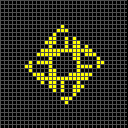
Symmetric patterns provide regions along the lines of symmetry where the rules are effectively different. Multiple copies of patterns can support / induct / suppress each other along mirror lines in ways that open up new kinds of dynamics, whereas asymmetric patterns in Conway's Life have a strong tendency to explode then collapse into known ash.

The symmetry effect is much stronger in some other rules. For example, in this denseflakes variant (randomly chosen first-found example, there are lots of these documented) asymmetric patterns generally don't explode

Code: Select all

x = 8, y = 2, rule = B2ci3ai4-a/S1e2i3ai4ae5ai6ac7c8
7bo$8o!
whereas symmetric patterns generally do:

Code: Select all

x = 8, y = 5, rule = B2ci3ai4-a/S1e2i3ai4ae5ai6ac7c8
7bo$8o2$8o$7bo!
User avatar
confocaloid
Posts: 6697
Joined: February 8th, 2022, 3:15 pm
Location: learn to protect yourself against stray gliders and sparks and self-destruct mechanisms

Re: Thread for basic questions

Post by confocaloid »

I'm not sure I follow the argument that a new replicator is more likely to be found in symmetric soups rather than in C1.

Here is a first attempt at a counter-argument. If you temporarily forget about replicators, and do not require the object to be a replicator, then for example the glider has So gliders in C4_4 seems to be roughly as common as in C1, and much less common in D8_4, if you count occurrences per submitted soup -- am I interpreting the data correctly? Is there something I'm missing?

Now, of course the glider is not a replicator -- but anyway the question becomes "What is it about elementary replicators specifically, that would make them more likely to be found in symmetric soups?"
  • Also, some time ago I had some (limited) success apgsearching several rules where C1 (asymmetric soups) is very hard/slow/memory-intensive to apgsearch, by switching to a higher symmetry. See for example the isotropic rule B36n/S237c where it was possible to apgsearch D8_1 and D8_4 symmetries, even though I failed to apgsearch the C1 census (with official unmodified version).
In other words, for some rules a higher symmetry may be less explosive and easier to apgsearch -- which means that some objects are less likely to occur in a higher symmetry of some rule.

(Tangential: the mentioned rule B36n/S237c has an interesting p30; here's a recent post by me, quoting also two earlier posts on the same rule.)
  • Further, here is a thought experiment (maybe not too convincing):

Code: Select all

#C Gabriel's p138
x = 21, y = 21, rule = B3/S23
11bo$10b3o$10bob2o$13bo4$2b2o4b2o$b2o10bo$2o11bo$b2o15b2o$7bo11b2o$7b
o10b2o$11b2o4b2o4$7bo$7b2obo$8b3o$9bo!
The Gabriel's p138 oscillator has a phase where it consists (ignoring dying sparks) of four copies of Octomino II.

Imagine an object P, which is something similar to the Gabriel's p138 oscillator, with the following differences:
(a) P is an order of magnitude more complex than Gabriel's p138.
(b) P is not an oscillator, but rather a "failed oscillator", which repeats with four cells toggled, and is subsequently self-destroyed.
(c) P has a relatively small predecessor, which is roughly as common as the loafer.
(d) P consists of four copies of a smaller active reaction X, similarly to how Gabriel's p138 consists of four copies of the Octomino II reaction. However, that active reaction X is an order of magnitude more complex than Octomino II. Also X (by itself) does not have any small predecessor whose commonness would be comparable to the loafer. In other words, P (four copies of X failing to stabilise each other) occurs (in rotationally symmetric soups) much more frequently than X by itself does.
(e) Actually, X is an elementary oblique replicator!

In this thought experiment, X is an elementary replicator that would successfully replicate, if it was the only thing in the universe; however, the most common way for X to occur is when a small predecessor evolves to P, four copies of X, which fail to give anything interesting, and do not survive to be recorded in the submitted haul. Then I would expect X (by itself) to occur in an asymmetric soup first.

Just to be clear: I agree that symmetric patterns provide regions where the rules are effectively different. It's just that I'm not convinced that this difference necessarily makes it more likely to see an elementary replicator.
hotdogPi wrote: February 22nd, 2023, 1:56 pm The best way to search for an elementary replicator is apgsearch with symmetric soups, i.e. we're already doing that.
mniemiec wrote: February 22nd, 2023, 10:14 pm It's not necessarily that the replicators themselves are symmetric; only that they are more likely to occur in symmetric soups. E.g. soups with 4-fold symmetries often yield 4 switch engines - and do so with much greater frequency than asymmetric soups yield a single switch engine.
dvgrn wrote: February 22nd, 2023, 10:49 pm Symmetric patterns provide regions along the lines of symmetry where the rules are effectively different. Multiple copies of patterns can support / induct / suppress each other along mirror lines in ways that open up new kinds of dynamics, whereas asymmetric patterns in Conway's Life have a strong tendency to explode then collapse into known ash.

The symmetry effect is much stronger in some other rules. For example, in this denseflakes variant (randomly chosen first-found example, there are lots of these documented) asymmetric patterns generally don't explode

Code: Select all

x = 8, y = 2, rule = B2ci3ai4-a/S1e2i3ai4ae5ai6ac7c8
7bo$8o!
whereas symmetric patterns generally do:

Code: Select all

x = 8, y = 5, rule = B2ci3ai4-a/S1e2i3ai4ae5ai6ac7c8
7bo$8o2$8o$7bo!

127:1 B3/S234c User:Confocal/R (isotropic CA, incomplete)
Unlikely events happen.
My silence does not imply agreement, nor indifference. If I disagreed with something in the past, then please do not construe my silence as something that could change that.
mniemiec
Posts: 1590
Joined: June 1st, 2013, 12:00 am

Re: Thread for basic questions

Post by mniemiec »

pipsqueek wrote: February 22nd, 2023, 10:21 pm
mniemiec wrote: February 22nd, 2023, 10:14 pm
pipsqueek wrote: February 22nd, 2023, 2:08 pmwho's to say that it will be symmetric? and how do you know its the best way? Im sure there is a more efficient specialized method of searching for replicators. if we haven't found one already, then maybe our search efforts aren't effective enough.
It's not necessarily that the replicators themselves are symmetric; only that they are more likely to occur in symmetric soups. E.g. soups with 4-fold symmetries often yield 4 switch engines - and do so with much greater frequency than asymmetric soups yield a single switch engine.
why?
"Why" certain results happen in CA (either in specific rules, or in general) is often difficult or impossible to quantify or explain. In most cases, all one can do is to observe actual statistical results, and make conjectures.
User avatar
dvgrn
Moderator
Posts: 12036
Joined: May 17th, 2009, 11:00 pm
Location: Madison, WI
Contact:

Re: Thread for basic questions

Post by dvgrn »

confocaloid wrote: February 23rd, 2023, 12:49 am Just to be clear: I agree that symmetric patterns provide regions where the rules are effectively different. It's just that I'm not convinced that this difference necessarily makes it more likely to see an elementary replicator.
Yeah, I don't think "more likely" / "less likely" in a statistical sense can be safely claimed here, in the absence of any actual evidence. We could come up with an unlimited number of thought experiments like the one above, some of which might need a particular type of symmetry, or else need no-symmetry.

For example -- assuming we're counting HighLife-style XOR replicators as "replicators" here -- soups with a line of symmetry might produce some kind of medium-sized blob that XOR-replicates along the line of symmetry. Or they might not... absolutely no way to quantify.

My very vague sense is that symmetric soups are a more auspicious place to look for things, just because more different kinds of structures can show up. But in the absence of running both symmetric and asymmetric searches until a nice statistical sample of elementary replicators is found (say a few hundred of them) (!) most theorizing about probabilities is pretty much just hand-waving.
User avatar
pipsqueek
Posts: 304
Joined: September 10th, 2022, 4:42 pm
Location: Abstract mathematical space

Re: Thread for basic questions

Post by pipsqueek »

what is the smallest rule 90 unit cell in Conways game of life?

Code: Select all

x=17,y=16,rule=B3/S23
3bo3bobo2bob2o$bobo4bo4b4o$bobo5bobo2b3o$b2obob2o3b2o$3o4b2ob2o2b2o$4b
o4bo$4b2obobob2ob3o$3ob3o2b2o$b3o2bobobo5bo$o3b2o3bobo2b2o$4bo3bob2o3b
o$2obo2bobobo2b2o$3b3o5bo2b2o$2obo4bo2bob2o$o3bob2obo3b2o$2bo8bobobo![[ STOP 3 GPS 4 ]]
User avatar
confocaloid
Posts: 6697
Joined: February 8th, 2022, 3:15 pm
Location: learn to protect yourself against stray gliders and sparks and self-destruct mechanisms

Re: Thread for basic questions

Post by confocaloid »

pipsqueek wrote: February 22nd, 2023, 2:08 pm Im sure there is a more efficient specialized method of searching for replicators. if we haven't found one already, then maybe our search efforts aren't effective enough.
For more efficient methods of finding interesting objects, the thread Is anyone studying the active part of soups? contains some interesting ideas that (I think) could lead to new discoveries.

It might be possible to turn those ideas into a way of finding interesting objects and interesting reactions, that would be more effective than the current apgsearch -- or at least that would complement the current apgsearch.

Inspired by the thread linked above, here's a similar idea/variation on the same idea. At every tick, when the new generation is computed, you can count separately:
  • the number of cells that are born via B3a;
  • the number of cells that survive via S2k;
  • the number of cells that die via D6n;
and so on -- for each of the 101 possible 3x3 conditions in the Hensel notation (excluding the B0/A0 condition), count how many cells in the previous generation were in this particular 3x3 condition. (B0/A0 is excluded because there are infinitely many cells in that condition.) This is more fine-grained than just the population; at any given tick, the sum of all 101 counts equals the population of the previous generation. Edit: the previous claim is wrong -- actually the population should be the sum of the 51 counts for S/D conditions (where the central cell is alive), not 101.

This might be helpful, because (for example) a replicator-like reaction could trigger some sufficiently rare (and thus detectable automatically) statistical anomalies in the resulting two-dimensional "log", where rows correspond to 3x3 conditions (B1c, B1e, B2c, ..., S7c, S7e, S8) and columns correspond to the generations (T = 0, 1, 2, ...) Likewise, a rare spaceship or oscillator could trigger some detectable statistical anomaly -- even if the object is temporary, not surviving in the final pattern. Even a partial oscillator, or a partial spaceship, or some other interesting object/reaction might be automatically detectable.

Code: Select all

#C The HighLife's replicator
#C As a simple unconvincing example, in the HighLife's replicator, the number of occurrences
#C of the D0 condition (an alive cell surrounded by eight dead cells) follows the sequence:
#C 0, 0, 1, 0, 2, 0, 0, 0, 0, 1, 0, 0, 0, 0, 2, 0, 8, 6, 1, 0, 0, 0, 0, 0, 0, 0, 2, 0, 4, ...
x = 5, y = 5, rule = B36/S23
2b3o$bo2bo$o3bo$o2bo$3o!
Of course, until someone actually implements this, and performs some experiments with this, and collects statistics, the above is mostly handwaving.
127:1 B3/S234c User:Confocal/R (isotropic CA, incomplete)
Unlikely events happen.
My silence does not imply agreement, nor indifference. If I disagreed with something in the past, then please do not construe my silence as something that could change that.
User avatar
Anivec
Posts: 2008
Joined: January 28th, 2022, 7:18 pm
Location: In 4.3 miles, take a right onto Exit 54

Re: Thread for basic questions

Post by Anivec »

What is the smallest infinite novelty, and can an infinite novelty generator be made up of switch engines to make a smaller one?
User avatar
pipsqueek
Posts: 304
Joined: September 10th, 2022, 4:42 pm
Location: Abstract mathematical space

Re: Thread for basic questions

Post by pipsqueek »

AlbertArmStain wrote: February 24th, 2023, 3:42 pm What is the smallest infinite novelty, and can an infinite novelty generator be made up of switch engines to make a smaller one?
you probably have seen this post, with my attempts to find a small infinite novelty (which is the same thing as chaotic growth obviously) and I did try to do that. as I look for smaller infinite novelties, I will add this to my toolbox:

Code: Select all

x = 18, y = 19, rule = B3/S23
16b2o$17bo6$3bo$2b4o$o4bo$o$o3$15b3o2$13bo3bo$13b4o$13bo!
may be possible to make an infinite novelty out of only switch engines, but it would be hard to create some sort of feedback loop.

Code: Select all

x=17,y=16,rule=B3/S23
3bo3bobo2bob2o$bobo4bo4b4o$bobo5bobo2b3o$b2obob2o3b2o$3o4b2ob2o2b2o$4b
o4bo$4b2obobob2ob3o$3ob3o2b2o$b3o2bobobo5bo$o3b2o3bobo2b2o$4bo3bob2o3b
o$2obo2bobobo2b2o$3b3o5bo2b2o$2obo4bo2bob2o$o3bob2obo3b2o$2bo8bobobo![[ STOP 3 GPS 4 ]]
User avatar
rattlesnake
Posts: 167
Joined: May 28th, 2022, 10:10 pm
Location: Following a 37P4H1V0

Re: Thread for basic questions

Post by rattlesnake »

Does metacatacryst count as infinite novelty?
User avatar
Anivec
Posts: 2008
Joined: January 28th, 2022, 7:18 pm
Location: In 4.3 miles, take a right onto Exit 54

Re: Thread for basic questions

Post by Anivec »

Can somebody give me a collection of 2-engine cordership + glider collisions?
hotdogPi
Moderator
Posts: 2290
Joined: August 12th, 2020, 8:22 pm

Re: Thread for basic questions

Post by hotdogPi »

AlbertArmStain wrote: February 28th, 2023, 10:42 am Can somebody give me a collection of 2-engine cordership + glider collisions?
It's probably easiest to write a program yourself.
User:HotdogPi/My discoveries

Periods discovered:

All evens ≤128 except 52,58,78,82,92,94,98,104,118,122

5-15,㉕-㉛,㉟㊺,51,63,65,73,75
1㊳㊵㊹㊼㊽,54,56,72,74,80,90,92
217,240,300,486,576

Guns: 20,21,32,54,55,57,114,117,124,126
SKOPs: 32,74,76,102,196
User avatar
confocaloid
Posts: 6697
Joined: February 8th, 2022, 3:15 pm
Location: learn to protect yourself against stray gliders and sparks and self-destruct mechanisms

Re: Thread for basic questions

Post by confocaloid »

AlbertArmStain wrote: February 28th, 2023, 10:42 am Can somebody give me a collection of 2-engine cordership + glider collisions?
Depending on what you are going to do with the results, it might be possible to use gencols or some other existing tool.

For example, the command

Code: Select all

# ./gencols.exe -pat obj/glider_nw.life obj/2ec_nw.life -nph 96 -tc 48 48 -gen 500 -del2 -filt ap | ./makerle.exe > test.rles
with the following file "obj/2ec_nw.life"

Code: Select all

#P
............*!............*.....***!...........*.*...**..*!............*...*.....*!............*...*!.................*..**!..................**...........**!...............................**!!!!!!!.***...................................**!.***.....................*.............**!..*............**.........**!...**.........*.***........**!....*.........*...*..........*!...*...........**.*.....*****!................*..........*!!!.**!.**!..*!..*!.*.*!*!.*..**!..*...*!....**!....*!!!!!!!......**!......**!...................*!...................***!....................**!....................*!!..................**.*!..................****!....................**!
and the following file "obj/glider_nw.life"

Code: Select all

#P
**.
*.*
*..
produces the following output in the "test.rles" file:
test.rles.txt
(201.65 KiB) Downloaded 49 times
However, note that
  • the results above are limited to collisions between an NW cordership and an NW glider,
  • the results are limited to those where the 2-engine cordership survives long enough after the collision,
  • the results may be even more significantly limited and/or incorrect due to my possibly incorrect use of gencols.
127:1 B3/S234c User:Confocal/R (isotropic CA, incomplete)
Unlikely events happen.
My silence does not imply agreement, nor indifference. If I disagreed with something in the past, then please do not construe my silence as something that could change that.
User avatar
pipsqueek
Posts: 304
Joined: September 10th, 2022, 4:42 pm
Location: Abstract mathematical space

Re: Thread for basic questions

Post by pipsqueek »

how can I make a GIF of a spaceship while keeping it in view? (by moving the point of view with the spaceship)

Code: Select all

x=17,y=16,rule=B3/S23
3bo3bobo2bob2o$bobo4bo4b4o$bobo5bobo2b3o$b2obob2o3b2o$3o4b2ob2o2b2o$4b
o4bo$4b2obobob2ob3o$3ob3o2b2o$b3o2bobobo5bo$o3b2o3bobo2b2o$4bo3bob2o3b
o$2obo2bobobo2b2o$3b3o5bo2b2o$2obo4bo2bob2o$o3bob2obo3b2o$2bo8bobobo![[ STOP 3 GPS 4 ]]
User avatar
toroidalet
Posts: 1514
Joined: August 7th, 2016, 1:48 pm
Location: My computer
Contact:

Re: Thread for basic questions

Post by toroidalet »

AlbertArmStain wrote: February 28th, 2023, 10:42 am Can somebody give me a collection of 2-engine cordership + glider collisions?
It's easy enough to do it yourself (even without any scripts). I will go over collisions where the glider hits the right (sparkier) side of a 2-engine Cordership:

Code: Select all

x = 44, y = 76, rule = B3/S23
22b2o$22b4o$22bob2o2$23bo$22b2o$22b3o$24bo$36b2o$36b2o7$39bo$38b2o$37b
o3bo$38b2o2bo$43bo$40bobo$41bo$41bo$41b2o$41b2o3$16bo10bo$15b5o5bob2o
11bo$14bo10bo3bo9bo$15b2o8b3obo9b2o$16b2o9b2o12bo$3b2o13bo21b3o$3b2o
35b3o7$11b2o$11b2o11b2o$22b2o2bo$27bo3bo$21bo5bo3bo$22bo2b2o3bobo$23b
3o5bo$31bo25$b2o$obo$2bo!
Since a 2-engine Cordership is asymmetric, we will need to handle collisions against it from all sides. Gliders are glide-symmetric and diagonal, so we don't have to cover each side of the Cordership twice; if both ships were asymmetric we would need to handle each reflection separately.
If we fix the location and phase of the Cordership, every glider can be uniquely characterized by two coordinates: the distance in half-diagonals between that glider and the one in the above pattern and the time it takes to reach the same row as that glider{a}. We can turn the problem of finding all glider-Cordership collisions into one of producing a grid where moving in one direction changes one of the coordinates of the glider, and moving in the other direction changes the other coordinate.
The locations of the gliders that hit the Cordership make a strip, which is periodic because the Cordership will return to its original phase after 90 generations. Here are two gliders that make the same collision:

Code: Select all

x = 44, y = 76, rule = TripleLife
22.2C$22.4C$22.C.2C2$23.C$22.2C$22.3C$24.C$36.2C$36.2C7$39.C$38.2C$
37.C3.C$38.2C2.C$43.C$40.C.C$41.C$41.C$41.2C$41.2C3$16.C10.C$15.5C5.C
.2C11.C$14.C10.C3.C9.C$15.2C8.3C.C9.2C$16.2C9.2C12.C$3.2C13.C21.3C$3.
2C35.3C7$11.2C4.2A$11.2C3.A.A5.2C$18.A3.2C2.C$27.C3.C$21.C5.C3.C$22.C
2.2C3.C.C$23.3C5.C$31.C25$.2B$B.B$2.B!
The gliders are separated by a vector of (16,32), corresponding to 32-16=16 half-diagonals. This means we have 16 cases to deal with.

To start, I made a grid of Corderships. Originally this was 200*16 with spacings of 200 cells, but it was expanded to 700*16 with spacings of 300 cells. I used the repeat script, but you could do this by hand.
16 is small enough that you could potentially treat each row individually rather than making a big grid. For the gliders, I made a similar grid, but the spacing was different:

Code: Select all

x = 303, y = 304, rule = B3/S23
b2o298bo$obo298b2o$2bo297bobo299$b2o298bo$obo298b2o$2bo297bobo!
As you can see, the gliders to the right are delayed 1 generation, while those on the bottom are 301 cells away instead of 300, so they appear 1 cell down relative to the Corderships. Then, I added a glider near the top left Cordership in a position where it would be ahead of the Cordership. In particular, any collision on that diagonal would have the glider behind that one.
After that, I pasted the glider grid over the Cordership grid. The first time I did this, it was obvious that 200 Corderships were not enough because the gliders at the end were hitting the Cordership, so I expanded it to 500, where the gliders at the right end did not hit the Cordership, but they weren't missing them entirely and it seemed like one backed up a little further could bump into a spark and make a collision, so I increased it to 700, and now the gliders at the far end were completely missing the Corderships. Then, I spent a bit of time removing all the non-collisions I could find, and ended up with 6,881:
Cordership collisions part 1.mc
(463.14 KiB) Downloaded 49 times
The blob in the lower right corner connects to the top right corner of the big strip if you tile it infinitely.

90° collisions on the other side of the Cordership can be found with the same method, and 180° and 360° collisions can be found similarly, except the strip there is a diagonal strip, and there are more than 16 lanes.

{a}: This is because a glider has a displacement of 1. A LWSS or a Cordership cannot be categorized by just two integer coordinates in a simple way like this.
Any sufficiently advanced software is indistinguishable from malice.
User avatar
confocaloid
Posts: 6697
Joined: February 8th, 2022, 3:15 pm
Location: learn to protect yourself against stray gliders and sparks and self-destruct mechanisms

Re: Thread for basic questions

Post by confocaloid »

toroidalet wrote: March 1st, 2023, 1:54 am Then, I spent a bit of time removing all the non-collisions I could find, and ended up with 6,881:
I tried to confirm the number of collisions with

Code: Select all

# ./gencols.exe -pat obj/2ec_nw.life obj/glider_sw.life -nph 4 -tc 100 195 -gen 300 -filt ap | ./makerle.exe
# ./gencols.exe -pat obj/2ec_nw.life obj/glider_sw.life -nph 4 -tc 100 195 -gen 300 -filt n | ./makerle.exe
and got 6884 collision RLEs for the first invocation and 213 non-collision RLEs for the second invocation.
6884_213.zip
(69.59 KiB) Downloaded 52 times
I guess the invocations are at least slightly reasonable, given that 6884 is close to 6881. I did not attempt to determine the difference (collisions which are present in only one of two sets).
127:1 B3/S234c User:Confocal/R (isotropic CA, incomplete)
Unlikely events happen.
My silence does not imply agreement, nor indifference. If I disagreed with something in the past, then please do not construe my silence as something that could change that.
User avatar
pipsqueek
Posts: 304
Joined: September 10th, 2022, 4:42 pm
Location: Abstract mathematical space

Re: Thread for basic questions

Post by pipsqueek »

How does the Speed Orthogoniod work? LifeWiki doesn't give any good explanation.

Code: Select all

x=17,y=16,rule=B3/S23
3bo3bobo2bob2o$bobo4bo4b4o$bobo5bobo2b3o$b2obob2o3b2o$3o4b2ob2o2b2o$4b
o4bo$4b2obobob2ob3o$3ob3o2b2o$b3o2bobobo5bo$o3b2o3bobo2b2o$4bo3bob2o3b
o$2obo2bobobo2b2o$3b3o5bo2b2o$2obo4bo2bob2o$o3bob2obo3b2o$2bo8bobobo![[ STOP 3 GPS 4 ]]
BokaBB
Posts: 2981
Joined: December 30th, 2019, 11:55 am
Location: Serbia

CGOL typewriter?

Post by BokaBB »

This is a little pattern idea I got.

Basically it's an user-controllable machine which the user could use by drawing a glider in a specific place. The machine would react to this in such a way that it would type the desired letter (basically make an oscillator or a still life on a certain spot via gliders) on a certain spot, shift the arm to the right of that position so it can type the next letter and go back to inactive mode.

I have no idea how to make any part of this but I think making the arm capable of moving to the right is gonna be a difficult task. Any idea about how to execute this?
777
I CAN APGSEARCH NOW!


Sure, I was a bad person, but I have changed myself.
I'd love to befriend anybody who's interested.
Have a good day!

BokaBB
User avatar
dvgrn
Moderator
Posts: 12036
Joined: May 17th, 2009, 11:00 pm
Location: Madison, WI
Contact:

Re: Thread for basic questions

Post by dvgrn »

pipsqueek wrote: March 2nd, 2023, 5:44 pm How does the Speed Orthogoniod work? LifeWiki doesn't give any good explanation.
Goldtiger997's post about the underlying design is here. Following posts include several sample patterns that can be inspected to see how the adjustability works.

(I haven't done an inspection like that recently enough to be able to write a coherent summary of the mechanism without subtle mistakes in it, so I can't say more -- it would be like asking ChatGPT to explain it.)
User avatar
dvgrn
Moderator
Posts: 12036
Joined: May 17th, 2009, 11:00 pm
Location: Madison, WI
Contact:

Re: CGOL typewriter?

Post by dvgrn »

BokaBB wrote: March 5th, 2023, 5:35 amBasically it's an user-controllable machine which the user could use by drawing a glider in a specific place. The machine would react to this in such a way that it would type the desired letter ...
This has been done already -- both the computer controlled version and the manually controlled version where you draw gliders to activate the printing of each character. You can recompile the printer to print whatever set of characters you want.
User avatar
Drelectron8
Posts: 154
Joined: March 5th, 2023, 4:54 am

Re: Thread for basic questions

Post by Drelectron8 »

Is this oscillator already found? Please let me know. It is a period-8 oscillator in High Flock.

Code: Select all

 x = 5, y = 2, rule = B36/S12
5o$b3o!
people, places :!:
User avatar
dvgrn
Moderator
Posts: 12036
Joined: May 17th, 2009, 11:00 pm
Location: Madison, WI
Contact:

Re: Thread for basic questions

Post by dvgrn »

Drelectron8 wrote: March 7th, 2023, 9:21 am Is this oscillator already found? Please let me know. It is a period-8 oscillator in High Flock.

Code: Select all

 x = 5, y = 2, rule = B36/S12
5o$b3o!
Offhand I don't know why no soups are showing up for it in Catagolue, but it seems to appear very frequently.
User avatar
Anivec
Posts: 2008
Joined: January 28th, 2022, 7:18 pm
Location: In 4.3 miles, take a right onto Exit 54

Re: Thread for basic questions

Post by Anivec »

Can we make a log(t!) growth?
hotdogPi
Moderator
Posts: 2290
Joined: August 12th, 2020, 8:22 pm

Re: Thread for basic questions

Post by hotdogPi »

AlbertArmStain wrote: March 8th, 2023, 12:56 pm Can we make a log(t!) growth?
https://conwaylife.com/wiki/Tlog(t)_growth

They're equivalent.
User:HotdogPi/My discoveries

Periods discovered:

All evens ≤128 except 52,58,78,82,92,94,98,104,118,122

5-15,㉕-㉛,㉟㊺,51,63,65,73,75
1㊳㊵㊹㊼㊽,54,56,72,74,80,90,92
217,240,300,486,576

Guns: 20,21,32,54,55,57,114,117,124,126
SKOPs: 32,74,76,102,196
User avatar
Drelectron8
Posts: 154
Joined: March 5th, 2023, 4:54 am

Re: Thread for basic questions

Post by Drelectron8 »

Is it possible to create your own rules eg. B367/S238, B347/S258 and post is on the life wiki? I would really want to know.
people, places :!:
User avatar
confocaloid
Posts: 6697
Joined: February 8th, 2022, 3:15 pm
Location: learn to protect yourself against stray gliders and sparks and self-destruct mechanisms

Re: Thread for basic questions

Post by confocaloid »

Drelectron8 wrote: March 9th, 2023, 7:26 am Is it possible to create your own rules eg. B367/S238, B347/S258 and post is on the life wiki? I would really want to know.
The intended purpose of the wiki is to collect more-or-less "established" information, i.e. knowledge that is "interesting" to multiple people. As a rule of thumb, you should not document your own discoveries, terminology, and so on on the wiki -- instead, you can post your stuff on the forum, so that other people can discuss it. If it's really interesting, someone else will document it sooner or later.

To answer your question specifically: For alien rules, there are two main threads in the OCA subforum where you can post your rules and patterns, so that people can see them:
127:1 B3/S234c User:Confocal/R (isotropic CA, incomplete)
Unlikely events happen.
My silence does not imply agreement, nor indifference. If I disagreed with something in the past, then please do not construe my silence as something that could change that.
Post Reply