
Hi all,
I'm new to these forums, and I'm also new to Conway's Game of Life (I have only been experimenting for less than 2 weeks).
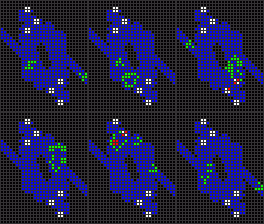
Anyway, I have found a methuselah which I think is new. Its properties are:
Initial population: 19
Bounding box: 7x7
Generations: 8200
Final population: 775
The pattern is as follows:
0 0 0 0 1 1 1
1 0 1 0 0 0 0
0 1 0 0 1 1 0
0 1 0 1 1 1 1
1 0 0 1 0 1 0
0 1 1 0 0 0 0
0 1 0 0 0 0 0
Have I discovered something new?
Edwin.
New 8200-generation Methuselah
Re: New 8200-generation Methuselah
Hi Edwin.
Methuselah for more than 7 cells are ill defined (as glider + blinker can "live" for long time before the collision).
The longest "real" methuselah (7 cells) lives for 5206 generations (see here).
So you can image 19 cell pattern will get higher expectations than 8000+ generations.
You can see more on long lived methushelahs here
--
As for your pattern you can reduce it to 14 cells in cost of 5 generations:
From your post I guess you're not familiar with Golly this is more or less the standard, many pattern here are copy-pasted from and to it, so no one actually bothers to say the obvious.
Methuselah for more than 7 cells are ill defined (as glider + blinker can "live" for long time before the collision).
The longest "real" methuselah (7 cells) lives for 5206 generations (see here).
So you can image 19 cell pattern will get higher expectations than 8000+ generations.
You can see more on long lived methushelahs here
--
As for your pattern you can reduce it to 14 cells in cost of 5 generations:
Code: Select all
x = 9, y = 6, rule = B3/S23
6b3o$4bo$6bo$bo4bo$2o$2bob4o!
From your post I guess you're not familiar with Golly this is more or less the standard, many pattern here are copy-pasted from and to it, so no one actually bothers to say the obvious.
Re: New 8200-generation Methuselah
Thanks for responding!
I see what you mean - in theory someone could create gliders and blinkers that are arbitrarily far a apart and therefore they "live" for a very long time.
However, in doing so the bounding box would be so large that it would be unimpressive.
From the Wiki page of "List of long-lived methuselahs" I see that 23334M is more impressive than mine - it has a smaller bounding box, and lower initial population (12 cells).
I will keep searching!
No, I wasn't aware of Golly. I implemented my own simulation and encoding method. But if Golly is the defacto standard I will publish further discoveries in that notation.
One question I have, is about your comment "the longest 'real' methuslah (7 cells)..." Does that mean 8 and more cells are not considered real methuselahs?
What criteria would be needed to qualify for an entry on the wiki page?
I see what you mean - in theory someone could create gliders and blinkers that are arbitrarily far a apart and therefore they "live" for a very long time.
However, in doing so the bounding box would be so large that it would be unimpressive.
From the Wiki page of "List of long-lived methuselahs" I see that 23334M is more impressive than mine - it has a smaller bounding box, and lower initial population (12 cells).
I will keep searching!
No, I wasn't aware of Golly. I implemented my own simulation and encoding method. But if Golly is the defacto standard I will publish further discoveries in that notation.
One question I have, is about your comment "the longest 'real' methuslah (7 cells)..." Does that mean 8 and more cells are not considered real methuselahs?
What criteria would be needed to qualify for an entry on the wiki page?
Re: New 8200-generation Methuselah
Well methuselah are just not so well defined, that's all. Up to 7 cells methuselah have good definition, beyond that is more about "impression".edwin wrote:One question I have, is about your comment "the longest 'real' methuslah (7 cells)..." Does that mean 8 and more cells are not considered real methuselahs?
I can't say anything for sure (have no rights on editing wiki), but my guess would be something with bigger life span, or final population, from same and preferably smaller initial population/bounding box etc.edwin wrote:What criteria would be needed to qualify for an entry on the wiki page?
Say pattern with 8 cells and small bounding box (say 5x5), which lives more than 7500 generations, or something of this sort.
Re: New 8200-generation Methuselah
It sounds like there needs to be a a formula or some other method of defining "impressiveness". In the wiki list of methuselahs, I don't understand why "Wake" is there. There are quite a few (Switch Engine, Multum in Parvo, Acorn, 7468M, and a few more) that all have both a smaller bounding box and lower initial population.simsim314 wrote:I can't say anything for sure (have no rights on editing wiki), but my guess would be something with bigger life span, or final population, from same and preferably smaller initial population/bounding box etc.
Say pattern with 8 cells and small bounding box (say 5x5), which lives more than 7500 generations, or something of this sort.
Maybe it's because I'm new, but it's not clear to me what I should get excited about and what is considered unimpressive.
For example, is a 8x6, initial pop = 11, generations = 15000 more or less impressive than 11x4, initial pop 10, generations = 15000?
There are some obvious things, such as:
For the same bounding box and initial population, a higher number of generations is better.
For the same bounding box and generations, a lower initial population is better.
For the same initial population and generations, a smaller bounding box is better.
But that's still not enough (in my view) to understand what is "worthy" of a record attempt.
-
Sphenocorona
- Posts: 549
- Joined: April 9th, 2013, 11:03 pm
Re: New 8200-generation Methuselah
Just want to mention that Gooly also supports pasting patterns into it which are in the same notation as yours, but with dead cells represented by '.' and live cells represented by any other visible character (usually 'o').
You're right, it's not notable. People often tend to go and add their 'discoveries' to the LifeWiki pages before they even check to see if it is actually new or notable, and the Wake, Ten, and Syringe entries there are the remnants of that sort of behavior which have not been fully cleaned up.edwin wrote:In the wiki list of methuselahs, I don't understand why "Wake" is there.
Re: New 8200-generation Methuselah
Actualy the 1s and 0s are not my notation - that was what I did to show the pattern without using any specific notation (I hadn't heard of Golly before). For what it's worth, my notation of the same pattern is this:Sphenocorona wrote:Just want to mention that Gooly also supports pasting patterns into it which are in the same notation as yours, but with dead cells represented by '.' and live cells represented by any other visible character (usually 'o').
000700070f4132f94c1000 (it's meaningless unless you paste it into my simulation software).
Oh, right, I see. I did wonder why they were there because they all seem superseded by more notable discoveries.Sphenocorona wrote:You're right, it's not notable. People often tend to go and add their 'discoveries' to the LifeWiki pages before they even check to see if it is actually new or notable, and the Wake, Ten, and Syringe entries there are the remnants of that sort of behavior which have not been fully cleaned up.
I'm still keen to find new long-lasting methuselahs, so I'll keep searching and if I find anything that I think is potentially notable I'll post it in these forums, and then perhaps that way the community can verify them as either notable or not notable. I'm very new to all this!

Re: New 8200-generation Methuselah
No idea how those stack against one another, but they both sound fairly impressive. There are probably quite a few patterns in that size range with lifespan > 10000, but finding them is not easy.edwin wrote:Maybe it's because I'm new, but it's not clear to me what I should get excited about and what is considered unimpressive.
For example, is a 8x6, initial pop = 11, generations = 15000 more or less impressive than 11x4, initial pop 10, generations = 15000?
A possible fourth rule:edwin wrote:There are some obvious things, such as:
For the same bounding box and initial population, a higher number of generations is better.
For the same bounding box and generations, a lower initial population is better.
For the same initial population and generations, a smaller bounding box is better.
But that's still not enough (in my view) to understand what is "worthy" of a record attempt.
• A methuselah that has few "peers" — patterns of the same cell count, about the same size, and about the same lifespan — is better than one that has many.
Though probably any "many-peered" methuselah can be exceeded by one that is strictly better on one axis and approximately the same on another.

Re: New 8200-generation Methuselah
What do you mean? Anonymous edits are not allowed anymore, because of amount of spam the wiki was getting, but you can easily register (if you know the first name of Professor Conway, of coursesimsim314 wrote:I can't say anything for sure (have no rights on editing wiki)
 ) and edit pretty much everything (except for a bunch of protected pages).
Ivan Fomichev
Re: New 8200-generation Methuselah
Hmm I didn't tried to create new page, but as far as adding images, editing or adding rle of synths etc. I failed.codeholic wrote: but you can easily register...and edit pretty much everything
Anyway I meant that I can't say what discovery has encyclopedic value, while just placing stuff in wiki - they will be deleted and considered spam, like this 19 cells "Methuselah".
Re: New 8200-generation Methuselah
Adding images should work: you just upload an image file. Adding patterns can be unfortunately done only by Nathaniel at the momentsimsim314 wrote:Hmm I didn't tried to create new page, but as far as adding images, editing or adding rle of synths etc. I failed.

They won't be considered "spam", that's for sure. Spammers are completely different from fair but naïve contributors.simsim314 wrote:Anyway I meant that I can't say what discovery has encyclopedic value, while just placing stuff in wiki - they will be deleted and considered spam, like this 19 cells "Methuselah".
Notability guidelines are quite clear. Another rule of thumb: anything that would fill a gap on Game of Life Status page is worth mentioning in the wiki (not necessarily in a separate article though).
Ivan Fomichev