
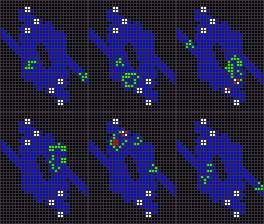
I had been thinking of Fredkin SALT Detusch Gate Model of Atom. Take a look at Fredkin SALT Detusch Gate. http://www.davesinvoice.com/papers/nonlocalneighbor.pdf
Now suppose this Gate was spaced by 1/r^2 probabilities the simulation will behave like a hydrogen atom with n=1 orbital. Universal Automata that can simulate physics is what Fredkin is after. What do you think?
Fredkin SALT Detusch Gate CA Model of Atom
Re: Fredkin SALT Detusch Gate CA Model of Atom
I was thinking of using CA's to simulate atom and here is the biggest problem I can see.
Atoms evolve by rules of differential equations, that means the "space" is continuous. On the other hand CAs are particle based i.e. the space is discrete.
Now obviously computers are also working in discrete space and can simulate continuous physics, so my "question" or more exactly the challenge that I see is: what advantage does CA have for simulating any differential equation?
-----------
On my opinion only particle systems can be nicely simulated with CA's like gases for example. But rigid bodies or atoms are not well suited to be simulated in discrete CAs. |I hope I'm wrong, but I couldn't find any elegant way to simulate any differential equation solver or rigid body with CA.
-
unhandyandy
- Posts: 2
- Joined: June 2nd, 2014, 10:12 am
Re: Fredkin SALT Detusch Gate CA Model of Atom
Some people (e.g. Wolfram) suspect the pde's are an approximation to an underlying CA.
Re: Fredkin SALT Detusch Gate CA Model of Atom
I don't think it's right and here is why: using CA you will usually have direction preferences. Even in hexagonal CA you will have 6 preferable directions.unhandyandy wrote:Some people (e.g. Wolfram) suspect the pde's are an approximation to an underlying CA.
Think of sun as object that emits "information particles", the usual CA will emit particles in N unique and distinguishable directions. This is because the underlying structure of this space is "divided" into regular discrete patterns. On the other hand our physical sun emits particles in all direction equivalently, this is due to the fact that our space is continuous, and has no preference to any particular direction.
Now don't get me wrong, of course you can make simulation using computers which are discrete information processing units, and present the result as if they were continuous. But there is no reason to think this is the case with physics. There is no straight forward and simple way to simulate our universe with discrete CAs, but one can definitely build continuous CAs.
Now just notice that our universe could have unique preferable directions, so this is logically valid statement, that our universe IS more probably continuous.
-
unhandyandy
- Posts: 2
- Joined: June 2nd, 2014, 10:12 am
Re: Fredkin SALT Detusch Gate CA Model of Atom
Hi Simsim,
There are a couple ways to respond to that objection.
1. There are a lot of really weird CAs out there, Wolfram catalogs them in New Kind of Science. One he particularly likes involves rewiring graphs.
2. A CA need not be nearest neighbor.
3. If cells are at the Planck scale or smaller the discreteness might not be detectable.
I don't know if Wolfram's idea is correct, but can't be dismissed out of hand.

Re: Fredkin SALT Detusch Gate CA Model of Atom
If the discreteness is not detectable, then what testable predictions can a CA model make about the universe, that could distinguish it from a continuous model? Seems as if the whole point of this exercise would be to hunt for real-life conditions where discreteness is detectable.unhandyandy wrote:3. If cells are at the Planck scale or smaller the discreteness might not be detectable.
If dismissing-out-of-hand is no good, I hope it's okay to express some healthy skepticism after thinking about it for a while. Until a CA-based model is proposed that seems to have some hope of explaining the apparent lack of directional bias in our observed universe, this still looks like a really good place to apply Occam's Razor. Discrete CAs tend to have measurable directional bias -- is there even a single known counterexample? -- whereas the universe doesn't, as far as we know. At this point the burden of proof still seems to rest with the proponents of a discrete-CA universe.unhandyandy wrote:I don't know if Wolfram's idea is correct, but can't be dismissed out of hand.
Re: Fredkin SALT Detusch Gate CA Model of Atom
Hi unhandyandy.
Your #1-2 comments are attacking the geometry. But notice that each cell has N neighbors. That means that some N "directions", even if not closest neighbors are preferable. If CA has some minimalistic regularity it's already prefers some direction, from "point source" on large distances.
Your #3 is clearly trying to answer some other question - like the attempt to connect quantum mechanics and discrete CA. Unfortunately the main issue with discrete CA is lack of "naive" unidirectional model.
----
The only way to get out of this issue is "totally irregular CA" which has clearly no advantage over "totally regular continuous CA".
By the way there is nothing "wrong" about continuity. Here is an example of thinking in other direction: trying to generalize discrete CA into continious one:
https://www.youtube.com/watch?v=KJe9H6qS82I